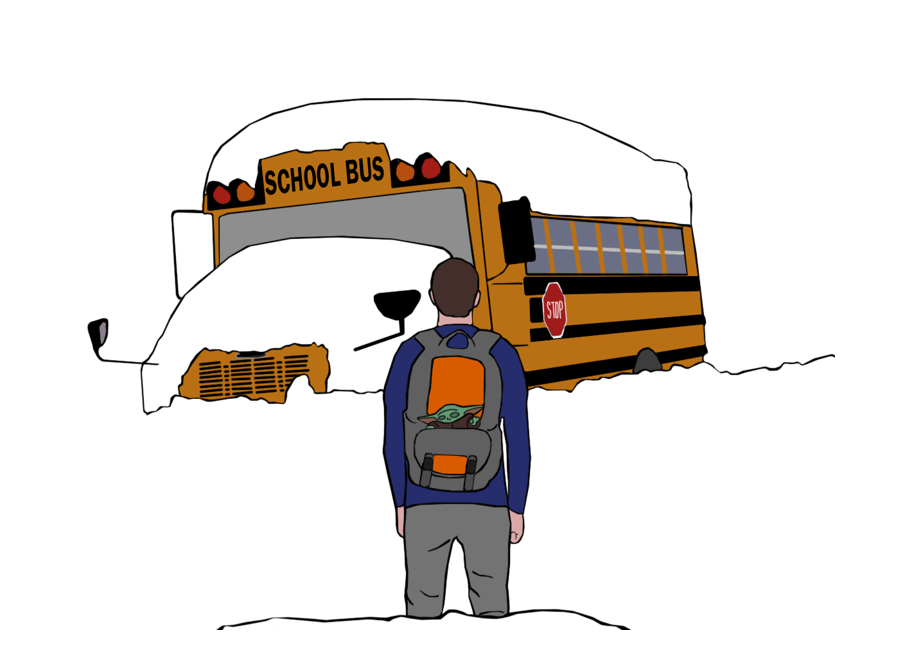
By Grace Otey // Reporter • Illustration by Matthew Barton
Warm hot chocolate, the bite of cold at your nose, piles upon piles of blankets. All while you watch movies with your family. Winter is a lot of things, a time to celebrate friends, a time to huddle by a fire, but it can also be dangerous.
The US Department of Transportation says that “Over 1,300 people are killed and more than 116,800 people are injured in vehicle crashes on snowy, slushy or icy pavement annually.”
So as winter approaches and the weather worsens, numerous questions come to mind. Is it safe to drive? Does this mean there will finally be a snow day? Will there be a delay? How will this impact school?
Spanish teacher Señor Rinne doesn’t think the snow at the beginning of this December warranted a snow day; however, he is all for snow days when they are needed.
“Honestly, I’m disappointed anytime we don’t have a two-hour delay and we could have, but we definitely did not need a day off,” said Rinne.
Student driver Vanessa Guynn experienced the conditions and begged to differ. She had to go through a neighborhood on her way home from school due to an accident on her usual route.
“I did encounter black ice when I was driving,” Guynn said. “I wasn’t gonna do the neighborhood, but since there was a car accident I had to go through this neighborhood. They did a terrible job with shoveling it, so I was going really slow, but I still did slide. It was really scary.”
Dr. Wyndham addressed the concern about road conditions.
“Opinions on what constitutes a ‘safe road’ could be very subjective and individualized based on each person’s perspective,” Wyndham said. “What you think is safe might be different from what I think is safe.”
So, if opinions and experience levels play such a big part in winter driving, how does the district ensure everybody can get to school safely? Wyndham explained the processes behind designating a delay or snow day.
“I start driving at about 4 a.m. on days where there is snow or ice and have a couple other administrators who drive as well. We each drive different parts of the district and then talk via phone about the road conditions at about 4:30 a.m. Typically at about 5 a.m. I speak with other superintendents in Hendricks County to discuss what we are all seeing and discuss what we are each thinking about doing in our respective districts. Some days I’m also speaking with town officials about their plans for treating roads throughout our community and what they are seeing.”
The process is thorough to say the least. Wyndham said his top priority is safety.
“Safety carries the most weight – however, I have to balance all the factors,” Wyndham said.
He described the difficult battle with E-Learning due to the state of Indiana’s restrictions. Indiana restricts E-Learning to three asynchronous days a year, the structure we typically use. This allows students to complete the assignments given to them throughout the day.
“We use one of those days in the fall – meaning I only have two additional days I can use for weather without having to make the days up. Our other option would be to shift to synchronous e-Learning – meaning teachers and students would have to be online at the same time for “live teaching” at least half of the day,” Wyndham said. “We have not utilized those and that would be a significant change for our teachers, families, and students.”
But that brings another question to mind, are E-Learning Days even worth it? If there is a restriction on our version of E-Learning days, why don’t we just let kids be kids and make it up later? Señor Rinne doesn’t think E-Learning is as productive as in person learning and it’s not worth it.
“E-Learning is garbage. If we’re going to have an E-Learning Day, I don’t think we should just say, oh, let’s make it E-Learning,” said Rinne. “Let a kid be a kid; they want to go play in the snow.”
Guynn felt the same way. She doesn’t think E-Learning is productive because kids just want to finish the work so they can play. However, when they rush through work, they don’t retain anything.
“Just a snow day would be better because kids aren’t gonna learn anything during E-Learning days,” Guynn said. “They’re gonna use AI, they’re not gonna learn anything.”
 THE ECHO
Leave a comment