By Nikola Meissner // Reporter • Illustration By Nikola Meissner
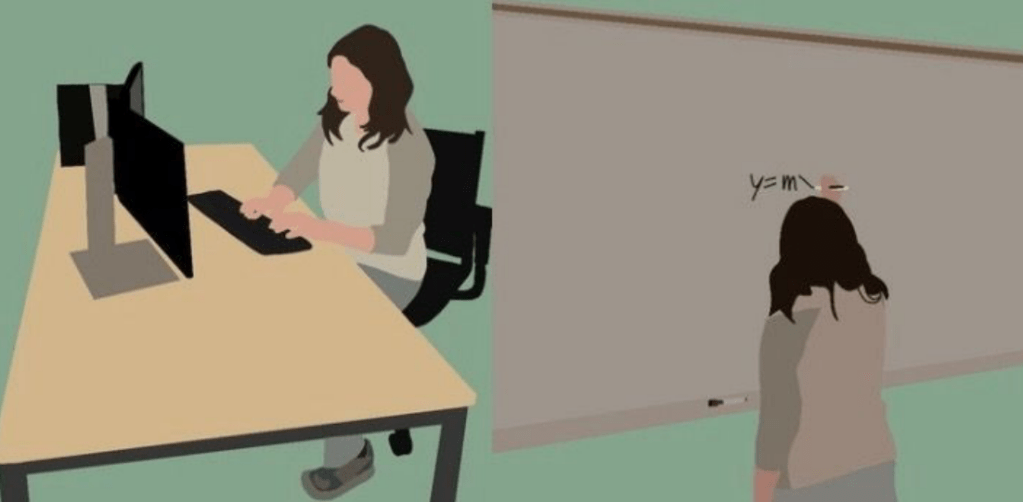
In her senior year of high school, it was time for Statistics teacher Amanda Leahy to make an important decision. Between juggling schoolwork and making a decision that would impact the rest of her life, she was also tutoring her peers.
“I was regularly tutoring about 10 other students in calculus, precalculus, and algebra 2,” Leahy said.
Leahy said she found that she had a talent for explaining math and felt that teaching might be something she was interested in. Yet her first semester of college, her decided major was Actuarial Science, but after not enjoying the accounting and business aspects, she ultimately majored in Mathematics Education at Purdue University.
As graduation season slowly creeps upon us, Avon High School seniors are finding themselves pondering the majors they have chosen to study. Teachers, like Leahy, offer their own college stories and advice to seniors who may find themselves struggling with confidence in their major.
Leahy recalls her experience of picking her major in high school as stressful. After being a straight A student her whole high school career and finishing salutatorian of her class, she was panicking.
“I was always really ‘good at school,’ Leahy said, “but really didn’t know what I wanted to do with my life.”
Leahy said she considered what kind of life she wanted. She said she knew that she wanted to have a family and be able to spend time with them as much as she could, but she also wanted to have hobbies and have time to pursue them. But those weren’t her only considerations when choosing a major.
“I also wanted a career that wasn’t boring. Teaching is never boring, and I get to interact with so many different types of people,” Leahy said. “But it is okay to do college on a budget. Remember that if you cannot financially afford to go to your top choice school, you can get a good education and career training at a lot of places.”
Leahy also said to remember that it is okay to change your mind about your major. History teacher Miranda Meadows agreed with Leahy’s point. Meadows, having changed her major herself, agreed that choosing a major is not easy when you are just a teenager.
“I just think it’s taboo because everyone wants to think they have everything figured out when they are 18,” Meadows said. “But it’s far more likely that people don’t and just don’t talk about it.”
Meadows was originally an Elementary Education major for her freshman and sophomore years at Indiana State University. After taking some foundational studies classes, she realized she had a passion for history and that working with elementary-aged kids was just not her speed.
“I realized that I just preferred a different energy,” Meadows said. “Elementary teachers have my utmost respect, but I just felt like my personality would fit in much more with an older set of kids.”
Meadows advised not to be afraid of changing your major and that getting stuck doing something you do not love is far worse than some extra time in school. For calculus teacher Anthony Record, his decision to change his major was about employability.
“I remember one of my first telecom classes as a freshman, sitting in a large lecture hall with over 300 people, thinking, ‘Am I going to have to compete with all these people for a job?” Record said.
Within two semesters of his college career, Record switched his major from telecommunications to secondary math education. Even when he was pursuing the telecommunication major, he continued to take math courses. After switching his major, he ended up completing his bachelor’s and master’s in secondary math education and is utilizing these degrees to the fullest.
“Currently, I am writing the AP Calculus curriculum for the U.S. Department of Defense to be used in face-to-face and online classrooms on or near military bases scattered around the world,” Record said. “I’m proud to say that I have conducted trainings or given workshop and conference presentations in 27 different states.”
Record advises that if you are iffy on a major now that it is not very likely to experience job satisfaction later on in life. Record and Leahy both encouraged students to follow their interests.
“Don’t force yourself to stay inside a career box you aren’t happy in,” Leahy said.
 THE ECHO
Leave a comment