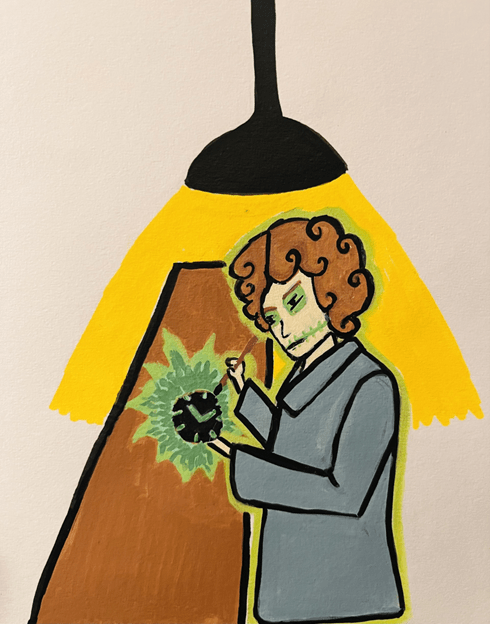
By Grace Otey // Reporter • Illustration By Grace Otey
At just 19 years old, Catherine Donohue started working at the Radium Dial Company; she didn’t know it at the time, but it was also the start of her decay.
After high school, Catherine got a job as a watch painter for the Radium Dial Company. Her and her co-workers were instructed to twirl the paintbrushes between their lips to get a precise edge; however, the paint they used was made of radium. Radium is a highly radioactive element. The same one that killed Marie Curie, but that was just from exposure. These women were ingesting the substance daily. The Radium Dial Company didn’t disclose the toxicity of the substance; in fact, they boasted about the health benefits. It was on the rage with celebrities and the wealthy at the time, so there was no way for the women to know the true risks.
“These Shining Lives” takes this tragic tale and transforms it into a story of female friendship. This year’s winter play follows Catherine and her deterioration and the women who support her. Director, Dr. Steckbeck describes the play as just that.
“That’s the point of the story, who is actually taking care of you in the end. It wasn’t the company, wasn’t the doctors, it’s her friends,” Steckbeck says.
The play mirrors Catherine’s life (granted there are a few details askew), beginning with her employment and ending with her death. On her first day she meets who will later become her best friends, Pearl, Charlotte, and Frances. These are the friends who will stand by her side throughout the rest of the story.
As the story progresses, Catherine begins to fall ill, mirroring her real-life decline. Catherine is decaying from the inside out with cancer finding its way into her bones.
Catherine is played by senior Cayce Hansel who finds those aspects to be the most difficult yet interesting to portray.
“My favorite part of the show right now is figuring out how we’re going to display that radioactiveness of how I’m going to deteriorate throughout the show,” Hansel said. “Also, the emotional depth of showing I’m deteriorating, not just physically, where my bones are coming out of my jaw, but also mentally, where I have to grasp the concept of, I am dying and it’s happening in front of me.”
Catherine’s time at the Radium Dial Company ends due to her excessive sick days, and more importantly, because she shared her struggles with her co-workers. Soon enough after she’s fired, Catherine files a lawsuit, another challenging aspect of her character.
“I think that’s something that’s hard to portray, especially at this time, where it’s this woman who is married and has children and doesn’t want to actively step up and take a role in the lawsuit, but has to, because she’s the worst case among the women. And so, I think it’s hard to portray that, where she just wants to sit down and be quiet and do her job, whereas she can’t just sit down and be quiet. She has to take action,” Hansel says.
It’s not just Catherine who suffers. According to the Library of Congress, Donohue was just one of many women from New Jersey, Illinois, and Connecticut. This includes her friends. The girls take care of each other in their times of need and represent the importance of female friendship.
“The one that’s getting sick the most, the other girls go and fill her with groceries, and they’re like, here your husband is at work, and you’re too sick to walk, so we brought you all this food,” Steckbeck says.
The Library of Congress says that “The Ottawa women had their hearing on July 23, 1937, with the Illinois Industrial Commission.”
Donohue and her colleagues won their case and all attempts by the Radium Dial Company at appealing were denied. It took three years, but they received justice.
Catherine lived to see her justice, even if she died soon after. She protected the lives of women to come and honored those who never got to sue. Her efforts live on in the development of laws and regulations protecting workers. And while she may not be the most illustrious hero her legacy lives on in stories like “These Shining Lives.”
 THE ECHO
Leave a comment