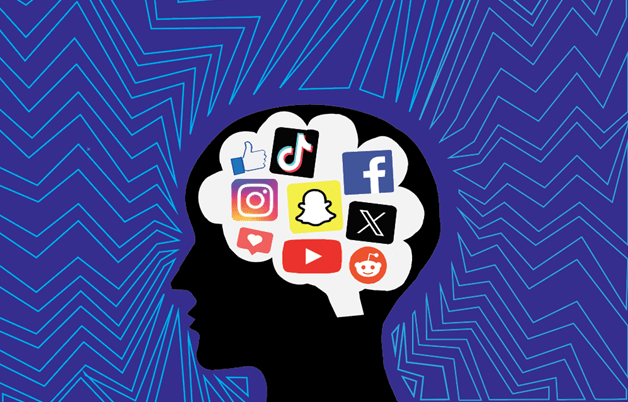
By Lauren Klein // Reporter • Illustration By Lauren Klein
Social media has grown increasingly popular among younger age groups. As it has become more popular, the question has become how has social media effect these age groups? Brain rot, memes, posts, and likes have become a huge part of people’s lives.
In a polling of 2,000 U.S adults, to figure out how many hours a year was spent on phones, laptops, and televisions.
6,259
This is the number of hours spent a year on technology. This equates to an average amount of 382,652 hours (about 43 and a half years) over the average lifetime of 60.7 years.
Junior Maddy Brown thinks that it is normal in the life that we live in.
“We live in this technology age,” Brown said. “I feel like it is an astonishing number but also not because we are just filled with technology”
Sophomore LJ Porter was astonished at the thought of this.
“I can say that it cannot be healthy in any way,” Porter said.
A poll done by YouGov of 18–29-year-olds in December on social media’s impact on mental health.
42.6
This is the percentage of 18-29-year-olds who were surveyed that believe social media has a positive impact on mental health.
Porter disagrees with these teens and believes there’s plusses and minuses to social media.
“I feel like it helps us with various things like staying up to date up on news and keeping in contact with family and others,” Porter said. “But it also harms us as people with like our self-confidence and or our uniqueness as individuals.”
In studies done by the World Health Organization, children on showing problems with social media behavior.
11
This is the percent of adolescents who showed signs of problematic social media behavior. These children struggled to control their use and experienced negative consequences.
13 vs 9
Out of the 11%, Girls reported higher levels of problematic social media use than boys, with 13% of girls and 9% of boys.
Junior Sarah Dieringer agrees with the idea that girls have a higher level of problematic social media use due to comparison.
“I mean it makes sense because girls on Instagram just seem to always compare themselves to each other,” said Dieringer.
The U.S. Department of Health and Human services is calling for increased transparency for companies to prioritize user wellbeing over revenue.
The American Academy of Pediatrics warns people that media use and screen time are associated with increased risks for young people. Typically, attention deficits, increased aggression, low self-esteem, and depression in a study done by American College of Pediatrics in 2020.
Along with that, The American Psychological Association (APA) found correlation between high social media use and a decrease in mental health among people under 18.
Pew Research Center did a poll in Fall of 2024 over parents and their concern over their child’s use of social media.
55
This is the percentage of parents who are extremely worried about their teen’s mental health.
44
This is the percentage of the 55% of parents who said they are worried about their teen’s mental health because of social media.
Porter believes that the parents are rightfully worried about their kid’s mental health.
“I’ve seen plenty of people take down posts or stress over the various reactions to their posts,” Porter said. “I think it could be healthy if people didn’t let it become their entire personality and mood.”
Porter is grateful for his parents and how they raised him for being safe online.
“It’s great because thanks to my parents I know how to be responsible online and allowing me to text friends and family along with releasing posts mindfully without being inappropriate or offensive to anyone,” Porter said.
YouGov did a survey of over 12,000 adults in December 2025 over adults’ opinions on social media for children under 16.
37
This is the percentage of adults surveyed who believe social media is extremely negative for children under 16.
In December 2025, Australia banned social media for children under the age of 16. The Australian Government said that the ban is needed to protect the mental health and wellbeing of Australian adolescents, believing the negative risks, such as cyberbullying, harmful content, and online predators, outweigh the positives.
Dieringer said that she does not necessarily want the ban in America, but she is not sure.
“Well, the adults haven’t used them when they were teens, so I don’t know if they should really have the full say,” said Dieringer.
Porter feels like a ban on social media would be neutral for adolescents.
“Whether or not someone’s social media impacts someone’s mental health is honestly based on the person and how they use it,” Porter said. “So, a ban could be okay for some people, be great for some people, or just be another day for some people.”
 THE ECHO
Leave a comment